How to Make a Website in 3 Easy Steps (for Beginners)
- Pick your website’s hosting provider and domain name
- Choose the right website building platform
- Design your website (and launch it)
How to Make A Website in 3 Easy Steps: Free Step-by-Step Tutorial for Beginners.
These three easy steps are designed to take the complication out of how to make a website. Now, if these three steps seem like a foreign language to you… know that you’re not alone. That’s why I’m here.
I’m going to guide you through all three of these steps (in detail), so that when you’re done here—you’ll be launching your own WordPress powered website.
No more worrying about how difficult making a website can be, just follow along as we go. Now, let’s get started!
1. Pick your website’s hosting provider and domain name
The first step in learning how to make a website is picking your website’s hosting provider.forexample wordpress
A hosting provider is the company that “hosts” your website, powering everything behind-the-scenes and keeping it live, visible on the Internet.
The hosting provider I recommend using is wordpress. They’re very affordable and have been around in the web hosting world for nearly two decades, powering some of the world’s most popular websites. They’re my pick mainly because their customer service is top-notch and always available to help troubleshoot any technical issues while you’re still going through the process of learning how to make a website.
Selecting your hosting plan.
Next, you’ll select the hosting plan that’ll power your website and make it visible on the Internet. I recommend their Choice Plus plan (which I originally used to make my website). It comes with their Domain Privacy feature, which hides your personal information (name, email, phone number and address) from being published anywhere online as the official owner of your website. With this plan, Bluehost protects that information on your behalf.
Any of these hosting plans will be fine as you’re learning to make a website—and you can always come back to add the domain privacy in later either during the checkout process or further on down the line for around $1/mo extra to your plan.
Next, you’ll need to pick a domain name for your website.
A domain name is your website’s address on the Internet.
Mine here, is ryrob.com, a nickname I’ve had for many years.
Your domain name should be at least somewhat related to either your business, your name or the topics you plan on writing about. It can be something like yourwebsite.com or bobscargarage.org. There are practically limitless options when it comes to picking a domain name (that’s available).
Here, you’ll type in the domain name you want your website to have.
If your first domain name of choice isn’t available (which is a likely possibility), you can either try another option that comes to mind—or (what I recommend) select the option to choose your domain name later after getting the rest of your hosting plan squared away and taking a little more time to think the website name through.
I cover much more about how to choose the right name for your website in this guide if you’re not yet decided.
Here’s where you can choose your domain later (it’s a popup that will appear if you hover on this page for long enough or move your mouse up toward the top of the page):
After either choosing your domain name or opting to pick it later, you’ll be taken to the final step in the sign up process—creating your account.
Creating your hosting account.
Fill in all of your account details (note: it’s important to use a current email address because that’s where your login details will be sent).
Getting right hosting package.
Here you’ll choose the account plan based on the price you want to lock in, and how far in advance you want to pay.

Note that Bluehost only offers options for you to pay 1, 2, 3 or 5 years upfront in one single payment. They don’t offer a monthly payment option (Dreamhost is a hosting company that does as are these other monthly hosting plans). But one advantage of using Bluehost, is that with whichever plan you choose, the price works out to be an overall better deal than just about any other hosting company can offer.
Which plan is the best?
I recommend the “Prime 36 Month Price” because it locks in the lowest possible price for hosting your website. That’s what I’ve used, and it guarantees your website hosting at their lowest rate (including the domain privacy) for the next 3 years. For that reason, I recommend going with the longest duration plan that your budget can spring for (to save on overall costs in the long run).
What about the extras? (Skip all but one)
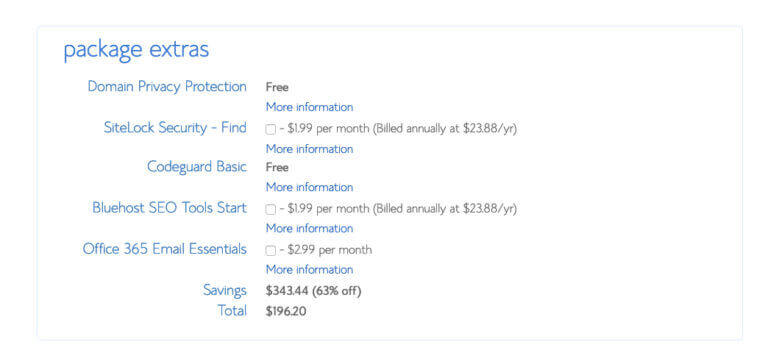
I recommend keeping the Domain Privacy Protection extra on your plan, but you can skip the rest. There are plenty of free and cheap WordPress plugins & blogging tools you can use for SEO, additional security, backups and getting email set up on your website—making most of these package extras not necessary for the average website owner.
The total you see is the amount you’re going to pay for getting your website online today. That means though, that you won’t have to pay again for 1, 2 or 3 years depending on the hosting plan you chose. Plus, Bluehost offers a 30-day money back guarantee if things don’t go as planned with your website.
Input your billing information.
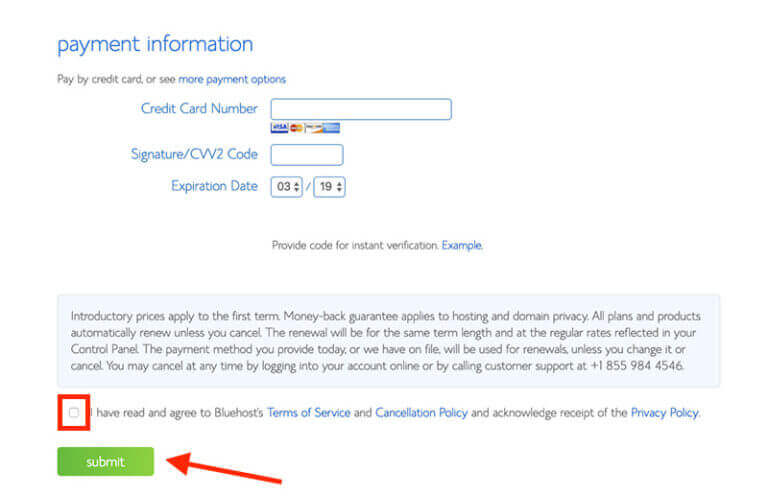
Finally, you’ll type in your billing information, check the box that you agree to their Terms of Service and then hit the green “Submit” button.
And… boom! 🎉
You just checked off the first (and biggest) step in how to make a website.
Now, on the very next page after completing your checkout with Bluehost, you’ll be guided step-by-step through the process of installing WordPress as the free website building platform on your website. This is where you’ll control the visual look of your website and where you’ll publish new pages or blog posts from.
An alternative website hosting provider to consider
Dreamhost: Remember, Bluehost doesn’t offer a true monthly billed hosting plan that allows you to pay month-to-month. Dreamhost does. Over the last decade, I’ve hosted over a dozen of my own websites on Dreamhost (and still do). They have most of the same features as Bluehost, like a 1-click WordPress installation, free SSL certificate and website
2. Choose the right website building platform
Of all the website building platforms on the market today, it’s estimated that WordPress powers upwards of 60% of the websites on the Internet.
Why? Because its hands down the easiest website builder to learn and also offers the widest range of customization abilities—not to mention it’s completely free to use.
That’s why I use it. That’s why millions of small business owners, bloggers and publishers use it to make their websites too.
What is WordPress? WordPress is a website building platform (started in 2003) to help publishers, businesses and bloggers quickly build, publish and maintain websites without having to hire a technical team to do it.
Now, to be fair, there are many other different website builders out there that you can consider—Wix, Squarespace, Weebly to name just a few.
A quick Google search will literally overwhelm you with options.
However, each and every one of these platforms will also require some sort of additional payment in order to use their building tools—ranging from $6 to upwards of $100/mo depending upon the features you need. Most will also require that you sign up for a hosting plan with them too (which will be more expensive than with Bluehost).
You don’t need to pay extra in order to have a good website building platform.
WordPress is free to use, and truly better than any other platform out there today. That’s what we’ll be using to make your website here today.
This version of WordPress is what’s called a self-hosted WordPress website—which is when you go out to secure your own hosting plan (through Bluehost) and then install free WordPress as the Content Management System (CMS) to power the design of your website.
Along with being free to use, WordPress also boasts well into the thousands of people who’ve built (both free and paid) themes and plugins you can use to very easily customize the look, feel and functionality of your website without the need to code at all.
What is a WordPress theme? A WordPress theme is a series of page templates and stylesheets that are used to dictate the appearance of a WordPress-powered website.
What is a WordPress plugin? A WordPress Plugin is a piece of software you can upload, that contains functions you can add to your WordPress website. They typically add more functionality or enable brand new features on your WordPress-powered website.
You can follow the short tutorial video above, to get WordPress installed on your website in a matter of minutes.
We’ll pick right back up here with the third and final step of our tutorial about how to make a website… designing and launching.
Keeping in mind that
3. Design your website (and launch it)

If your eventual plan is to make money from your website, you’ll want to build an aesthetically appealing site that’s easy to navigate.
All copyrights reserved to 256jaquardug
 256jaquardug